Scriptures of Hinduism

Open your life's doors towards the Hindu Wisdom - the most ancient and extensive religious writings in the world.

Ayurveda - The science of life

The 'veda' (science) of 'ayur' (life span) - Indian system of medicine is a gift of the 'vedic' age

Secrets of Hindu Customs and Rituals

The Hindu culture is a culture of love, respect, honoring others and humbling one's own ego so that the inner nature, which is naturally pure and modest, will shine forth.

A to Z of Yoga Sastra and Meditation

Learn yoga sastra. Also learn yoga postures, poses, asanas and more

Temple Database

Know about Hindu Temples in and outside India

Showing posts with label Rishikesh. Show all posts

Sunday, 20 November 2011

Rishikesh


Rishikesh is a famous religious place also known as the Yoga Capital of the World. Rishikesh is popular amongst devotees, yoga persons and adventurers as well. Located on the banks of the sacred Ganga River, Rishikesh attracts thousands of pilgrims every day from India as well as abroad. There are several ancient temples and ashrams in Rishikesh which are associated with our mythological and historical background. A dip in the holy water of Ganges flowing from the river beaches of Rishikesh is capable of washing all the sins of a person. Rishikesh is also popular because it acts as the starting point for salvation trip to the Char Dham  pilgrimage which includes Badrinath, Kedarnath, Gangotri, and Yamunotri.

CLICK HERE FOR HINDI DESCRIPTION
ऋषिकेश को पवित्र तीर्थ माना जाता है। गढ़वाल, उत्तरांचल में हिमालय पर्वतों के तल में बसा ऋषिकेश धार्मिक दृष्टि के अतिरिक्त अपने प्राकृतिक सौन्दर्य के लिए भी प्रसिद्ध है। हिमालय की निचली पहाड़ियों और प्राकृतिक सुन्दरता से घिरे इस धार्मिक स्थान से बहती गंगा नदी इसे अतुल्य बनाती है। ऋषिकेश को केदारनाथ, बद्रीनाथ, गंगोत्री और यमुनोत्री का प्रवेशद्वार माना जाता है। कहा जाता है कि इस स्थान पर ध्यान लगाने से मोक्ष प्राप्त होता है। हर साल यहाँ के आश्रमों में बड़ी संख्या में तीर्थयात्री ध्यान लगाने और मन की शान्ति के लिए आते हैं। ऋषिकेश पर्यटन का सबसे आकर्षक स्थल है। विदेशी पर्यटक भी यहाँ आध्यात्मिक सुख की चाह में नियमित रूप से आते रहते हैं।

स्थिति

भारत के सबसे पवित्र तीर्थस्थलों में एक ऋषिकेश है जो उत्तराखण्ड में समुद्र तल से 1360 फीट की ऊँचाई पर स्थित है। हिमालय का प्रवेश द्वार ऋषिकेश हरिद्वार से लगभग 20-25 किलोमिटर की दूरी पर स्थित है यहाँ से पर्वतों के राजा हिमालय का साम्राज्य शुरू हो जाता है।

कथा

ऋषिकेश से संबंधित अनेक धार्मिक कथाएँ प्रचलित हैं। कहा जाता है कि समुद्र मंथन के दौरान निकला विष शिव ने इसी स्थान पर पिया था। विष पीने के बाद उनका गला नीला पड़ गया और उन्हें नीलकंठ महादेव के नाम से जाना गया। एक अन्य अनुश्रूति के अनुसार भगवान राम ने वनवास के दौरान यहाँ के जंगलों में अपना समय व्यतीत किया था। रस्सी से बना लक्ष्मण झूला इसका प्रमाण माना जाता है। 1939 ई. में लक्ष्मण झूले का पुनर्निर्माण किया गया। यह भी कहा जाता है कि ऋषि राभ्या ने यहाँ ईश्वर के दर्शन के लिए कठोर तपस्या की थी। उनकी तपस्या से प्रसन्न होकर भगवान ऋषिकेश के अवतार में प्रकट हुए। तब से इस स्थान को ऋषिकेश नाम से जाना जाता है।

यातायात व परिवहन

वायुमार्ग
ऋषिकेश से 18 किलोमिटर की दूरी पर देहरादून के निकट जौली ग्रान्ट एयरपोर्ट नज़दीकी एयरपोर्ट है। इंडियन एयरलाइन्स की फ्लाइटें इस एयरपोर्ट को दिल्ली से जोड़ती है।

रेलमार्ग
ऋषिकेश का नज़दीकी रेलवे स्टेशन हरिद्वार है जो 25 किलोमिटर दूर है। हरिद्वार देश के प्रमुख रेलवे स्टेशनों से जुड़ा हुआ है।

सड़क मार्ग
दिल्ली के कश्मीरी गेट से ऋषिकेश के लिए डीलक्स और निजी बसों की व्यवस्था है। राज्य परिवहन निगम की बसें नियमित रूप से दिल्ली और उत्तराखंड के अनेक शहरों से ऋषिकेश के लिए चलती हैं।

Rishikesh is the ideal destination for adventurer’s activities like rafting, trekking, rock climbing, kayaking, mountaineering etc.

Rishikesh is situated 25kms ahead of Haridwar at an elevation of 356mts above sea level. Rishikesh consists of three distinct areas known as Rishikesh, Swargashram and Muni-ki-Reti. It is believed that when Raibhya Rishi did rigorous penances here, the God appeared to name the place as Hrishikesh and subsequently the place came to be known as Rishikesh. Numerous spiritual Yoga and meditation centres are located at Rishikesh which are regularly visited by large number of tourists from all over the world.


Rishikesh is a Yoga capital of India and famous for Yoga, Spa Meditation, Rafting and Camping, Adventure tourism in India. Rishikesh is best weekend getaway break destination from Delhi.


इससे बड़ा नक्शा देखें


Friday, 11 November 2011

Neelkanth Mahadev Temple, Rishikesh

Originally posted on : http://nayna.in/

May 29, 2008

A temple with patient devotees…a temple with no touts, no one to force you to pay up for a special VIP doorway. A temple where you can take your time and pray without hearing the words “Move Ahead, Keep Moving.” 

Does this sound unbelievable? Trust me, I was surprised too.
Nestled on a high mountain top with pristine waters of the holy Ganges below, devotees are invited to seek blessings from Neelkanth Mahadev in Rishikesh.

Neelkanth Mahadev is none other than Lord Shiva. This name befell on him because of a precarious feat he undertook because he could not see his devotees suffer. The Puranas state that during the churning of the ocean-Samudra Manthan, there came out a poison called-Halahal. The venom was exceptionally powerful that it could annihilate mankind. The gods were distressed and didn’t know how to destroy it. Lord Shiva stepped in and decided to drink it.

Mahima (Magnanimous Aura) of Lord Shiva is divine. He surely drank it but did not swallow the poison. He allowed it to remain in his throat. This venom turned his throat blue. Neel defines the color blue, Kanth is throat and Mahadev means Lord of the gods. Lord Shiva came to rest in Rishikesh. The gods tried hard to comfort him and ultimately decided to pour water on his head to cool him off. This is one of the reasons why even today, devotees offer water to Lord Shiva.

After several years of rest and meditation, Lord Shiva removed the poison from his throat and left it on a mountain. He returned to his abode, Mount Kailash in the Himalayas. Later a temple was build around this and now stands as symbol of Lord’s grace at a height of 1675 m.

A drive of 32 km. from Rishikesh via Barrage or an alternate route of 22 km. via Ram Jhoola can get you there with ease. The scenic beauty was breathtaking as on one side was the mountain terrain and the other side was a steep drop into the fast flowing Ganges.
The holy water of Ganga was much cleaner as compared to the water that flows through Haridwar and Varanasi. The current was tremendous and so river rafting was an extremely popular sport here. Tourists worldwide visit this city for this adventurous thrill.

The temple’s car park was lined with stalls selling offerings for the deity. It consisted of coconut, a sealed-plastic glass containing water from the Ganges, Bel leaves, assorted-fresh flowers, fruits like dhatura and jujube, box of incense sticks, small Chunnari (piece of red veil) and a laminated photograph of the Lord Shiva with the backdrop of the temple.

As I walked ahead, I was taken aback by the temple’s architecture. The entire Samudra Manthan was depicted with colorful idols of all the gods and goddess. One look at it and the entire Puranic story flashes in front of your eyes. The architecture is extremely well-maintained and the photographs don’t do enough justice to them. Photography is not allowed inside the temple so I was forced to take as much as I could from the outside.

I stood in line to enter the inner sanctum. A life-sized idol of goddess Parvati was seated near the entrance. Her striking grandeur forced everyone to bow and offer their obeisance. The arena around the lingam was made of marble. There were detailed etchings of guards or Dwarpals on the columns with intricate detailing that showed their weapons. Opposite the lingam was Lord Shiva’s mount Nandi, the bull.

Devotees kept chanting “Om Namah Shivay” and finally it was my turn. I sat in from of the lingam which was encased in silver. It had an opening at the top to see the original form. I poured the water from the Ganges while a priest seated, chanted the Vedic mantras and helped me complete my worship.

At the exit of the sanctum, there was a gigantic Pipal tree. Devotees had tied chunnaris to it. I guessed that it was for their wishes that needed to be fulfilled. But I really didn’t have anything to wish for. Getting a darshan like this was more than what I had dreamt of.

I feel that if you really want solitude with Lord Shiva, you will get it here in Rishikesh. Even the 12 Jyotirlings won’t give you the solace because of the packed crowds and touts.

Jyotirling at Mallikarjun in Sri Sailam, Andhra Pradesh, Mahakaleshwar in Ujjain, Madhya Pradesh, Rameshwaram in Tamil Nadu, Trymbakeshwar in Nasik, Nageshwar near Dwarka and Somnath in Gujarat do not allow always devotees to touch the Lingam. Security concerns, crowd management and arrival of VIP dignitaries can dampen your spirits. I hope my travel experiences give you a clear idea how to get personal one on one time with Lord Shiva.

©Nayna, 2007-2008. All Rights Reserved.(http://nayna.in/)


View Larger Map

Friday, 4 November 2011

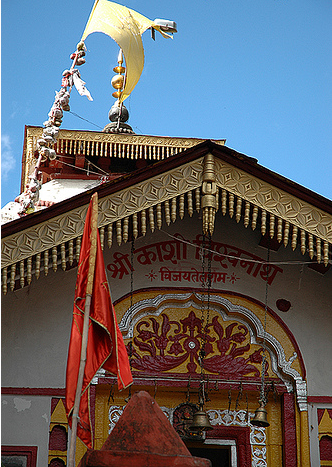
Viswanath Temple, Uttarkashi

Uttarkashi is situated at a distance of 154 kilometres from Rishikesh, on the Rishikesh- Gangotri route. The Viswanath Temple is the most important and ancient holy shrine in this region. Of the many temples in Uttarkashi, the temple of Lord Vishwanath is unrivalled in importance. Shiva, the presiding deity of this temple, is worshipped all day here. Every evening, visitors are greeted by the sound of bells, and the chanting of mantras by pundits at the puja.Within the courtyard of the Vishwanath temple, and to the front of it, is the Shakti Temple, dedicated to the goddess of strength.

 The massive brass trident projecting from this temple bears an inscription describing how the Vishwanath Temple was built. According to it, the temple was built by King Ganeshwar, whose son Guh, a great warrior, built the trident. 26 feet high, this trident's base measures 8 feet 9 inches, and its top, 18'/2 inches in circumference.


>  The town of Gopeshwar also features a Shiva Temple and a trident with Sanskrit inscriptions. It is much smaller.
View Larger Map